
Insights

Latest Insurance Talent Perspectives

Competing for Technology Talent

Technology talent continues to be in high demand as insurers work to enhance customer experience, increase operational efficiency, personalize their offerings and compete in a quickly evolving environment.

Read our blog post for ways to be strategic and intentional in overcoming this talent challenge and effectively appealing to candidates within the technology space.

Explore Our Full Thought Leadership Library

  • Reset

Jacobson Employee Spotlight – Mar. 2020

As a people-focused organization, The Jacobson Group is dedicated to our employees and their professional development. On Employee Appreciation Day 2020, we’re highlighting two of our staff members in particular. First is Caitlyn Manuel, corporate recruiting manager. Caitlyn won last quarter’s Bravo award, which recognizes individuals who have exemplified outstanding performance, service, and commitment to our core values and goals. Second is Matthew Moore, client development manager, who is new to Jacobson but has already made an impact. You can view previous editions of our Employee Spotlight here. CAITLYN MANUEL Corporate Recruiting Manager, 6 years, 10 months at Jacobson Hometown: Chicago Heights, Illinois Alma Mater: Eastern Illinois University Describe Your Role: As the corporate recruiting manager on the HR team, I'm tasked with strategically engaging and recruiting candidates for our various internal positions.    Favorite Thing about Jacobson: I love the camaraderie among the employees. There's a feeling of home and family every time I walk through the doors at work, and it's something I never take for granted. Jacobson in Three Words: Family, Collaborative, Supportive Best Advice: If you're early, you are on time. If you're on time, you are late. Favorite Movie: Jurassic Park  MATTHEW MOORE Client Development Manager, 1 month at Jacobson Hometown: Whitesboro, New York Alma Mater: Hofstra University Describe Your Role: I connect with our clients and take time to focus on understanding their needs. My goal is to be a consultant they can rely on and trust by bringing them the talent they are looking for.   Favorite Thing about Jacobson: I love the way Jacobson presents itself to clients. It's great knowing that I have a very strong brand behind me when I'm doing an introduction with a new client.  Jacobson in Three Words: Intelligent, Motivating, Engaging Favorite Food: Tomato pie from Roma Sausage & Deli Weekend Plans: You can find me playing hockey with friends. Last month was Insurance Careers Month, when insurance professionals and companies come together to share why they love insurance and inspire more people to join the industry. Though February has wrapped up, you can get more insights by viewing our Insurance Careers Month 2020 video series or subscribing to our blog using the form on the right-hand side of this page.

Insurance Labor Study Results: Continued Opportunities for Candidates

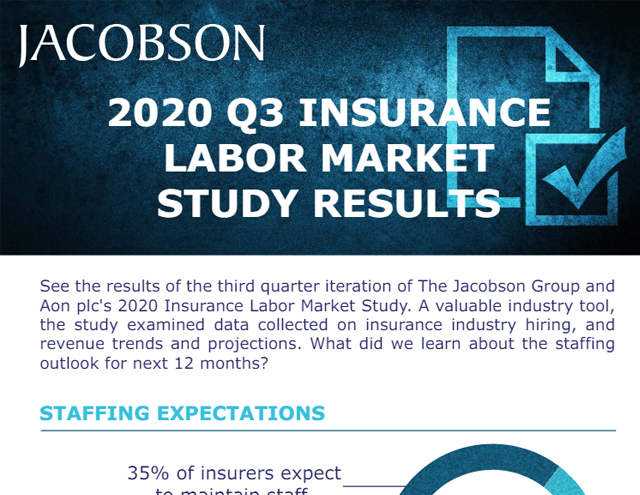
We recently completed the Q1 2020 iteration of our Semi-Annual U.S. Insurance Labor Outlook Study, and the results are now available! The study, conducted by The Jacobson Group and Aon plc, collects revenue and hiring projections from carriers across the insurance industry. We’re highlighting some of the latest findings below. Download the full results summary, recorded webinar and slide deck for additional insights and commentary. The January 2020 survey found positive revenue and staffing expectations in the insurance industry, with all segments foreseeing growth this year. Sixty-one percent of organizations polled plan to increase staff in the next 12 months, and 77 percent expect revenue growth. Though these numbers are both relatively flat compared to one year ago, many insurers are actually exceeding anticipated growth. In January 2019, 5 percent of insurers expected a staffing increase of more than 20 percent; in actuality, 7 percent grew their staffs by that amount. Again, 5 percent of companies expect to increase staff by more than 20 percent in the coming year. The latest study revealed technology, underwriting and claims roles to be most in-demand. In the past year, the need for underwriting, actuarial and compliance talent increased. For the first time, the study also surveyed companies’ recruiting plans in terms of employee levels. Overall, insurers are seeking mid-level staff (those with roughly five to 10 years of experience) at a much higher rate than entry-level or management/executive employees. This year, the majority of insurance carriers expect to maintain their use of temporary employees. However, 13 percent plan to employ more interim staff in the coming year. In part, companies may be planning to use temporary personnel to remain productive as they fill more challenging full-time positions. In fact, insurers saw an uptick in recruiting difficulty for all disciplines except claims and sales/marketing. As you explore opportunities within the industry, differentiate yourself from other professionals looking into insurance careers by creating a personal brand that emphasizes human skills; learning how to effectively share stories and connect in networking settings; and subscribing to The Career Catalyst (on the right side of this page) to be the first to read our exclusive insights into career management, professional development and more.

Insurance Labor Study Results: Insurers Remain Optimistic in a Difficult Recruiting Climate

The results from the Q1 2020 iteration of the Semi-Annual U.S. Insurance Labor Outlook Study are now available! Conducted by The Jacobson Group and Aon plc, the study has uncovered the insurance industry’s revenue and hiring trends for 11 years running. We’re highlighting key statistics from the latest results below. You can download the full results summary, recorded webinar and slide deck for additional insights and commentary. January’s survey showed largely positive staffing expectations: 61 percent of respondents plan to increase staff in 2020, down just 1 point from July 2019. Life and health lines and property and casualty (P&C) balanced lines are leading this effort as 71 percent and 67 percent expect staff growth, respectively. Forty-eight percent of companies planning to add staff expect an expansion of business or entry into new markets. In total, only 8 percent of companies anticipate a decrease in staff this year. Expectations to grow revenue remain high across the industry, at 77 percent, decreasing just 2 points from our July survey. Seventeen percent of companies expect revenue to remain flat in 2020, unchanged from our July report. Both P&C and life and health companies responded that expected revenue shifts for 2020 will be driven by changes to market share, at 54 percent and 67 percent, respectively. Across the board, recruitment difficulty is still increasing, fueled by “continued low unemployment, mass retirements and job growth incited by modernization efforts,” according to Gregory P. Jacobson, co-chief executive officer of Jacobson. As in our July 2019 survey, actuarial, technology and executive positions are the most difficult to fill. Nine of the 11 categories measured in the study increased in recruiting difficulty, and accounting surpassed the threshold for moderate difficulty for the first time. A variety of trends will impact the talent landscape in 2020. However, prioritizing succession planning for long-term success; developing a culture of change to support modernization; and engaging with efforts like the Insurance Careers Movement, which shares why young professionals should consider a career in insurance, can help your organization remain competitive. While the insurance industry grew 0.72 percent in 2019, versus an anticipated rate of 1.19 percent, we are seeing continued growth. If the industry stays true to its plans for the next year, employment will again increase. To access the latest growth projection, along with additional insights into the labor outlook for the next year, download the full results of the study.

Goal Setting: Taking a SMART Approach in 2020

As we near the end of February, it’s an ideal time to reflect on your department’s 2020 goals and expectations. Has your team made any progress toward achieving those goals? Are you on track to hit milestones? It is easy for employees to get distracted by smaller, but perhaps more pressing, tasks throughout the workweek. If your longer-term goals have been moved to the back burner, you’re not sure how to measure your team’s progress, or you’re not aligned with enterprise-wide initiatives, it’s time to reevaluate the goals you set at the beginning of the year. By taking a fresh look, you can redefine those goals to make them strategic, SMART and positioned to make a larger overall business impact. It’s likely you’ve encountered SMART goals at some point in your professional career. To review, these are goals created with the following criteria: Specific - Think through who, what, when, where and why as you set your goals. Make them as specific as possible.  Measurable - How will you know when your goal is accomplished? This should be stated in a way you can tangibly measure.  Attainable - Given the timeframe and your resources, is this something you can accomplish? If so, how will you get there?  Relevant - Make sure your goal is a priority and will have an impact once you accomplish it. How will meeting your goal impact you? Your team? Your company? Timely - Have a timeframe for meeting your goals. This may mean breaking a larger goal up into smaller pieces to ensure it remains a priority. The SMART goal framework should be at the foundation of the priorities and activities you set for your department or functional area. By creating SMART goals for your employees, you’ll be able to set your team up for success and generate the greatest impact. With this in mind, also consider the following in your goal-setting process. Larger Business Goals To be most relevant and impactful, your team’s goals and priorities should be working toward larger goals set by the department and company. If you haven’t already, take a look at your organization’s enterprise-wide goals for the year and analyze how those goals cascade down to your department or function. What part of each goal is your team responsible for? Is it a particular percentage of revenue? Helping to get a new product or project off the ground? Determine the role your team plays in meeting overall business goals and build your department goals from that information. Then, define the activities that need to occur in order to move the needle. This could be reducing the time it takes to complete certain tasks, implementing new project management systems or increasing customer satisfaction ratings, to name just a few. Once these goals and activities are clearly defined, consider the contributions each employee will need to make in order to collectively achieve them.  Sense of Employee Ownership Employees should always be advancing the goals of the company. Once your department goals are set, ensure employees also have clear and personalized individual goals for the year. By setting SMART goals for your team members, they will clearly understand expectations and have well-defined paths forward. Explain what the company is trying to achieve, how your team’s goals support those goals, and the pieces each employee is responsible for. Encourage employees to participate in creating their goals; proactively ask for their ideas and feedback, while ensuring the goals are clearly understood and agreed upon. Build excitement by highlighting how employees’ individual contributions support the success of the larger department and company. And, ensure they know their specific roles are a valuable component of the overall organization’s success. Checkpoints and Celebrations  Once you set goals, it’s important to periodically check in on your team’s progress. Afterall, it’s much easier to course correct if there are six months left in the year than just a few weeks. Your checkpoints may be monthly, quarterly or before major milestones. Consider each of the specific goals and how much guidance and support an individual employee may need. At the same time, celebrate reaching major milestones or tracking ahead of your initial projections.   Goals are not meant to be set and forgotten. Clearly define how you expect to grow from the past year and the activities that need to take place to reach your 2020 goals. As a manager, it’s important to understand what the company is aiming to accomplish and your team’s responsibility in meeting those goals. Keep the larger business picture at the forefront as you prioritize projects and ensure all employees are clear on how they can make the greatest organizational impact.

Jacobson Employee Spotlight – Feb. 2020

Every February, insurance professionals and companies celebrate Insurance Careers Month with the goal of sharing why they love insurance and inspiring more people to join the industry. As a proud founding member of the Insurance Careers Movement and partner of #ICM2020, we’re dedicated to our employees and their professional development and growth.  Each month, we highlight a couple of our corporate employees as they share a bit about themselves and their roles. Get to know these individuals below. You can view previous editions of our Employee Spotlight here. WINNIE LI Account Manager, 3 years, 8 months at Jacobson Hometown: Chicago, Illinois Alma Mater: DePaul University Describe Your Role: As an account manager for our contingent workforce solutions team, I strategically engage with our clients and candidates to provide exceptional service throughout each partnership.   Favorite Thing about Jacobson: I always look forward to our annual celebrations. It is great to see everyone and catch up with our remote employees. Jacobson in Three Words: Collaborative, Inclusive, Energetic Surprising Fact about You: I love to cook any and all dishes. Favorite Weekend Plans: I would be at Target telling my fiancé we need one thing and leaving with a full cart of items but not with the one item we needed.  TYLER WILSEY Human Resources Generalist, 5 years at Jacobson Hometown: Niles, Illinois Alma Mater: Columbia College Chicago Describe Your Role: I am involved in various cross-enterprise projects. I onboard our new internal employees, manage internal benefits, and am Jacobson’s corporate trainer and project manager.   Favorite Thing about Jacobson: I love hosting Jacobson’s new hire orientations and being the first friendly face our employees spend time with.  Jacobson in Three Words: Dynamic, Collaborative, Competitive Surprising Fact about You: I love to sing. I met my wife in a choir we were in together. Bucket List Item: I want to travel to Costa Rica to visit Territorio de Zaguates, a cageless dog sanctuary. Learn more about Insurance Careers Month by clicking here. Join the conversation on social media with #ICM2020 and #InsuranceCareersMonth.

Taking Stock of Your Succession Plan in 2020

As we enter a new decade, most professionals are reevaluating their career paths and setting career goals. This may mean taking on continuing education courses, getting in line for a promotion or even evolving their management strategies. However, it is important that leaders also think about the future of their organizations. When is the last time you took a thorough look at your succession plan? Is it up to date? Have your organization’s goals and needs shifted since its initial creation? The industry, as well as its employment landscape, is continuing to evolve. Technology and automation are redefining roles, new roles are being created (such as “head of wearables” or “chief automation officer”), and Baby Boomers are retiring at a steady pace. In fact, CEO turnover is at the highest level in nearly 20 years and the majority of insurers would be unable to replace their CEO in the event of an emergency. In today’s fluid employment market, succession planning is much more involved than in the past and the best future leaders are not always an obvious choice. Organizations must account for a number of factors including new business goals, individuals’ personal aspirations and needs, and flight risks. A well-developed and comprehensive succession plan should look several years into the future and account for any critical roles and skillsets. Recently, our senior vice president of human resources, JoJo Harris, and senior vice president of executive search and corporate strategy, Judy Busby, penned an article on creating comprehensive succession plans that will contribute to long-term organizational success. They expounded on the following areas: Creating both a succession plan and a replacement plan. Planning for future goals and needs. Including your most critical roles in your plan. Involving employees in the process. Continually re-evaluating your needs. To learn more about putting these best practices into action, along with how prioritizing succession planning can help meet your business goals, retain top performers and lay the foundation for ongoing success, read the whitepaper, “Prioritizing Succession Planning for Long-Term Success.”