
Insights

Latest Insurance Talent Perspectives

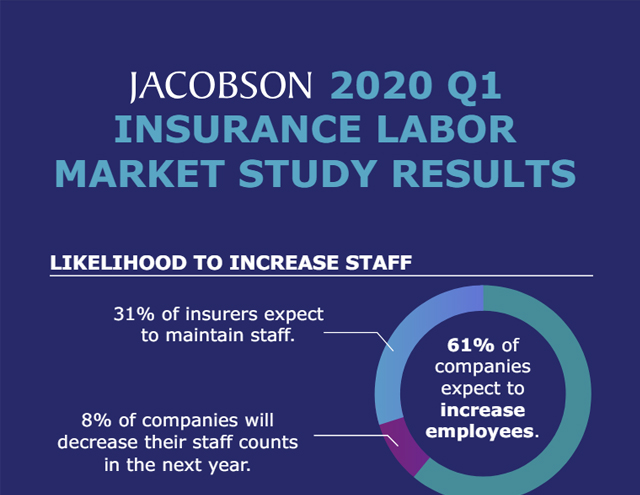
Q1 2026 Insurance Labor Study Results

Explore staffing projections and hiring plans for the U.S. insurance industry for the next 12 months.

Download the results from the Q1 2026 iteration of The Jacobson Group and the benchmarking division of Aon’s Strategy and Technology Group’s Semi-Annual U.S. Insurance Labor Market Study. A valuable industry tool, the study examines data collected on insurance industry hiring and revenue trends and projections.


The Changing Face of Insurance Talent

Understand, support and develop the industry’s next generation of leaders.

Download the white paper for strategies to help your organization better understand emerging generations, foster meaningful mentorship and build a future-ready workforce poised to lead the industry forward.

Competing for Technology Talent

Technology talent continues to be in high demand as insurers work to enhance customer experience, increase operational efficiency, personalize their offerings and compete in a quickly evolving environment.

Read our blog post for ways to be strategic and intentional in overcoming this talent challenge and effectively appealing to candidates within the technology space.

Explore Our Full Thought Leadership Library

  • Reset

Seven Tips for Recruiting During the Holiday Season

The holiday season is a unique time of year from a recruiting standpoint. On one hand, professionals are often on a break from their current jobs and may be evaluating their long-term professional goals. Conversely, potential candidates and internal staff often have conflicting schedules, making it difficult to coordinate interviews and keep momentum going. As this year’s holiday season kicks off, there are a few things employers should consider in terms of their hiring strategies. 1. Adjust your expectations. With end-of-year projects, 2020 planning, vacation time and holidays, the upcoming months have their own set of challenges and competing priorities. As a result, talent strategies must be approached a bit differently. Level set expectations with your team to account for non-work days (including employees’ personal vacation days) and extended timelines. Recognize that posting a job the week of Thanksgiving may not yield a new hire in December. However, attracting top talent, arranging interviews and establishing strong connections is very much a possibility. 2. Plan ahead. Planning is key to ensure your recruiting efforts maintain momentum during the holiday season. Align with your team and all stakeholders involved in a search. Especially if you are looking to fill a role immediately, it’s important you know which days your team members are available for interviews and commit to a tentative process and timeline. Talk through what is realistic with your team and plan goals accordingly. You may also consider using an insurance recruiting firm to assist with certain roles, or leveraging a temporary staffing partner to help fill any gaps in employment. 3. Acknowledge it’s still a candidate-driven market. While it may be the holiday season, it’s not the time to put off conducting interviews and making job offers. October unemployment was at 1.7 percent for insurance and the Bureau of Labor Statistics most recently reported there are 262,000 open jobs in finance and insurance. Your competitors aren’t on hiring freezes these next few months; they’re actively recruiting top talent. If you’ve found a stellar candidate, don’t wait until after the holidays to extend an offer. It is likely they’ll have already accepted another role. 4. ...But be respectful of candidates’ schedules. No matter how pressing an opportunity is, don’t call candidates on the actual holidays themselves. For instance, while many companies are open on Christmas Eve and New Year’s Eve, that is not the right time to be reaching out to schedule an interview. Wait until the day after the holiday and understand if candidates are unable to talk right away due to existing vacation schedules and family responsibilities. Exceptions to this rule may include presenting a candidate with a job offer or sharing other pertinent news, as long as the timeline has been agreed upon in advance. 5. Exercise flexibility. Whether you’re flying a candidate in for an interview or working around your team’s internal schedules, it may be necessary to get creative. For instance, if a key decision-maker is out of the office, schedule a Skype interview instead of postponing an in-person conversation. Also consider meeting before or after business hours, recognizing many individuals are juggling their current roles, children home from school and holiday coordination. Be understanding of personal obligations throughout the holiday season and try to accommodate candidates with additional options and flexibility. 6. Freshen up your job postings. The end of the year is a time when many individuals reflect on their careers and their next professional steps. Additionally, many who are looking for a change are using their time off as an opportunity to browse job postings and consider their options. Repost your high priority jobs so they stand out at the top of the list, rather than looking stale or out of date. Take a look at your existing position descriptions and ensure they are compelling and not overwhelming from a requirements standpoint. Consider making adjustments so they focus on specific skills, rather than experience, to broaden the talent pool. 7. Promote your brand. Make sure your employment brand is visible and accessible during the holiday season. If you’re advertising jobs on social media sites such as LinkedIn, make sure your posts are updated and active. Showcase your company culture by sharing highlights from company parties, charity events and social gatherings across all your social profiles. Many job seekers are honing their company research when they have time away from their current positions. By having an enticing brand, you can help attract individuals to your current openings and also build your talent pipeline moving into 2020. While the holiday months bring their own challenges, there are plenty of opportunities for those who adjust their talent strategies accordingly. With realistic expectations, early planning and a flexible mentality, it’s possible to attract the right talent in time to help ring in the new year.

How to Keep Employees Motivated During the Holidays

The holidays seem to arrive earlier every year. Before you know it, your employees will be inundated with out-of-town guests, holiday travel, meal planning and gift shopping. Get ahead of the distractions with these tips to make sure your team stays on task for a productive holiday season. Set Project PrioritiesDuring the holidays, employees may take vacation time in addition to company-wide days off, potentially impacting end-of-year projects. Remember to take time off into account when creating project plans; preparing for those extra days early on will help your team successfully complete projects without added stress. Setting precise and measurable deliverables, especially as we enter the holiday season, will ensure staff members stay productive. Start planning with your team now to prioritize projects and then break those projects into smaller, achievable tasks with clear deadlines. Employees’ input will be vital in setting realistic, manageable goals. This will help you identify gaps in resources and set your team up for continued success when you get back up and running in January.Consider Flexible Work ArrangementsSome insurers are still reluctant to implement work-at-home (WAH) or flexible work arrangements, though they’ve become more common. However, even small gestures such as closing the office a couple hours early or allowing your employees to work from home one or two days around the holidays can strongly impact their motivation and morale. Your staff will feel more capable of managing both work and personal obligations, giving them more time to enjoy the season and helping them return to work refreshed. For organizations that have embraced WAH arrangements, well-defined policies are essential to success. Kids home on school break could be a distraction, for example, but parents can better set physical and time-based boundaries with your help. Drafting guidelines around remote work environments and expected work hours will give your staff the structure they need to maximize productivity. Specific considerations may include your preferred method of communication for quick updates versus more in-depth brainstorms or meetings, how many check-ins you expect per day, and whether your employees should let their managers know when they’ve started their day and when they’re getting ready to log off. OvercommunicateOnce essential tasks are prioritized and flexible work arrangements are set, make sure to communicate those expectations and schedules to any involved team members and stakeholders. Overcommunicating during this time will ensure no loose ends are left for the new year. Precise, written communication establishes an accessible record of expectations, but phone or in-person follow-ups are advisable to verify everyone is on the same page. While determining priorities is a necessary first step, straightforward communication is also an essential part of the process; clarity and alignment will ensure coverage for essential day-to-day tasks and a smooth project path. Overcommunication is important when initially sharing project expectations and creating back-up plans for out-of-office coverage but also extends to team-wide time management. During this process, help your employees learn to accurately communicate their workloads so they can better manage their time and delegate when appropriate. Additionally, ensure your team knows who will be physically in the office, remote or on vacation in the weeks surrounding the holidays. Share each employee’s active work hours and any preferred communication methods so no one struggles to connect while working against the clock.Plan for Talent GapsEven with the best prioritization, flexibility and communication, last-minute demands may arise while your employees are away from the office. After all, insurance needs don’t take days off, even for the holidays! Promote team alignment and cross-departmental collaboration to fill in the gaps, and rekindle your relationships with insurance-focused staffing firms to cover any additional needs. Staffing firms stay connected to skilled talent so they can provide the consultants you’re looking for at a moment’s notice. Finally, do your best to accommodate employees as they balance work and personal needs. Just as you may be dreading that visit from Aunt Josephine or struggling to find a gift for the neighbor who grabs your newspaper while you’re out of town, your employees also deal with these holiday troubles. It’s up to you to set the tone for work around the holidays, help alleviate unnecessary office stress when possible and of course, to celebrate with your team!

The Actuarial Mid-Level Talent Gap: An Update

It’s no secret the actuarial world has been facing a mid-level talent gap. In a white paper last year, “The Actuarial Talent Challenge: Combatting the Mid-Level Gap,” we examined some of the causes for this gap and ways insurers were working to close it. As we near the end of 2019, we’re taking a fresh look at the trends impacting the actuarial world and this still very relevant talent challenge. Recruiting actuaries for mid-level roles has been difficult for the past several years. There are multiple reasons these individuals, with eight to 15 years of experience, are scarce compared to their younger and older counterparts. Often mid-level professionals are in dual-income relationships, have already laid down roots in their communities and/or have young children, making moving for new roles difficult. In other cases, they may have specialized in a specific area, and their experiences seem difficult to translate across departments. Some may have moved to other industries and taken similar roles during the recession, causing further impact. While the talent gap is showing few signs of letting up, there are ways companies can combat this hurdle by being creative in structuring their departments and flexible in optimizing their teams and talent. Reexamination of Roles and DepartmentsOne of the most noticeable shifts we’re seeing is organizations having unique needs, creating different reporting structures and working to better define actuarial roles. Some companies are flattening their departments, while others are maintaining more traditional models. A number of organizations are working toward more centralized structures, while others are more dispersed. At the same time, they are examining roles and reassigning projects that are out of scope, such as moving ownership of self-built systems over to IT. This creates case-by-case challenges, as there is no one-size-fits all solution for best managing today’s actuarial teams.Soft SkillsAs organizations reimagine their actuarial roles, there’s a need to determine the specific skill sets that are necessary for future success. Automation has impacted all areas of the industry. As modernization projects progress and companies leverage artificial intelligence, new sets of skills are in demand. Soft—or human—skills are separating the good from the great actuaries, as they are able to better translate data and most efficiently leverage systems and teams. Organizations that once only looked at specific experiences and specialties must focus on individuals’ soft skills, both from a recruiting and training perspective. By recruiting for skills over specific experience, insurers will be exposed to qualified individuals they may have once overlooked, while also benefiting from attributes only humans can master. PrioritizationAs the echoes of the last recession dissipate, it’s common for organizations to want to tackle multiple projects that were previously put on hold. Actuarial leaders must determine their top priorities and then build agile teams that align with those areas of emphasis. This may mean being more creative and flexible than ever before. According to the Bureau of Labor Statistics, actuarial employment is expected to grow 20 percent between 2018 and 2028. By prioritizing their unique needs, actuarial leaders can strategically hire and develop the right talent to achieve their department and business goals. Remote WorkThis year, we’ve seen a great increase in remote hiring. Video conferencing, group messenger apps, online project management platforms and shared documents are just a few of the tools making remote work a seamless option. While the right mid-level candidates may not be available within a reasonable commute, telecommuting options enable organizations to hire qualified professionals, regardless of geography. Work/Life BalanceThere’s an abundance of young actuaries vying for entry-level roles; organizations need to focus on growing and retaining that talent to eventually fill the mid-level gap. Reflect on what your company is offering that would make it enticing for mid-career individuals. For instance, by embracing work/life balance and flexibility in hours and work location, organizations can foster work environments that make it easier to balance personal and professional obligations. Alternative SolutionsAs organizations combat the mid-level gap, they are leveraging a variety of alternative talent solutions to augment their actuarial workforces. In the past several months, many companies have looked to offshoring for actuarial functions. Currently, the impact of offshoring has been limited to entry-level positions and has seen mixed reviews. While it could potentially bleed into mid-level roles as insurers become more comfortable incorporating offshoring into their talent strategies. However, while offshoring can complement existing solutions, it presents its own challenges, such as different time zones, morale issues and turnover. Insurers are also increasing their use of subject matter experts as gig workers, who can lead and support new projects on an as-needed basis. As insurers redefine roles and organizational structures, these individuals can them help maintain performance levels, while working toward larger goals.As an industry, we’ve done a fantastic job encouraging young talent to seek out actuarial careers. By further developing this talent, understanding the needs of mid-career professionals and looking into non-traditional talent solutions, insurers can help eventually close the talent gap. In the meantime, actuarial leaders can mitigate its impact by reexamining their teams, prioritizing projects and taking a flexible approach to department structures.

Jacobson Employee Spotlight – Nov. 2019

At The Jacobson Group, we’re dedicated to our employees and their professional development and growth. Each month, we highlight a few of our corporate employees from across the company as they share a bit about themselves and their roles. Get to know these individuals below. View last month's edition of our Employee Spotlight here. ALEC DATOLI Client Development Manager, 7 months at Jacobson Hometown: St. Charles, Illinois Alma Mater: Elmhurst College Describe Your Role: As a client development manager, my goal is to help our clients make a successful placement. I focus on being a readily available, professional consultant who aids and supports the client with all of their sourcing and hiring needs. Favorite Thing About Working at Jacobson: My favorite part is my colleagues. I get to work with such smart, energetic and inclusive people everyday, which has made my transition into a new company a lot easier.  Jacobson in Three Words: Thought-Provoking, Collaborative, Fun Favorite Dessert: Grandmother's homemade pecan pie Surprising Fact: I once ate three meals in three different countries in a single day. NADA IBRAHIM Recruiter, 1 year, 6 months at Jacobson Hometown: Cairo, Egypt Alma Mater: University of Illinois at Chicago Describe Your Role: As a recruiter on the talent delivery team, I partner with our clients to recruit for various interim openings and opportunities.  Favorite Thing About Working at Jacobson: I love our work environment and culture. My favorite event is our annual meeting because I get to connect with all of my coworkers. Surprising Fact About You: I can sing "You've Got a Friend in Me" in Arabic. Best Advice: Always ask when you don't know. Ideal Lunch Break: I'd make a stop at the taco truck and then take a walk in the park. CECILIA MWAYA Recruiter, 4 years at Jacobson Hometown: Lusaka, Zambia Alma Mater: Baptist Bible College Describe Your Role: As a recruiter, I partner with our clients to identify long-term matches for their organizations. There's never a dull moment. Fun fact: I am the only recruiter in the company who has worked for all three divisions, and I love them all.  Best Piece of Advice Ever Given: Never be afraid to go after what you want. It may not be easy, but it's always worth it. If you don’t try and just stay where you are, you’ll never know what you are capable of achieving. Favorite Thing About Working at Jacobson: I help facilitate our "lunch for a lunch" service event. I love it because we come together to make lunches for local homeless people.  Favorite Music: Currently the ever enigmatic Lizzo and all things '70s slow jams Superpower: I am the queen of bargain hunting. If there’s a coupon for something, I've got it. DEVIE SMITH Manager of Accounting, 11 years at Jacobson Hometown: Lithonia, Georgia Alma Mater: The University of Georgia Describe Your Role: I truly love my job as manager of accounting. My day-to-day involves general ledger management and financial statement generation. I also manage the financials and payroll of the organization, which allows me to work with all of my coworkers.  Jacobson in Three Words: Family, Collaborative, Open Favorite Event at Jacobson: I love our Vegas celebrations as a large group! Surprising Fact About You: I was born in Riyadh, Saudi Arabia, and lived there until I was 8 years old. Bucket List Item: I would like to go parasailing at some point.  If you’re interested in joining our corporate team, check out our open positions here.

Save the Ghosting for Halloween: Don’t Let Your Professional Reputation Haunt You

There’s a new ghastly trend running rampant among job seekers. Within the past couple years, ghosting has become a common occurrence, with 83 percent of employers reporting they’ve been ghosted by a candidate. Originally a term reserved for the dating world, ghosting has expanded into the professional realm. Loosely defined, it describes a person not showing up or becoming unreachable—with no notice, explanation or follow up—at any point in the employment process. This could mean skipping interviews, stopping communication with recruiters and hiring managers, or even neglecting to show up for a first day of work. In today’s candidate-driven market, there are more open jobs than there are candidates to fill them. The national unemployment rate is at a 50-year low of 3.5 percent and insurance unemployment has fallen even lower, currently at 2 percent. Professionals are recognizing the ball is in their courts when it comes to job searching, and are often receiving inquiries and offers from multiple companies. At the same time, a high-tech recruiting environment makes it easy to evade emails and screen phone calls. It seems many job seekers are more comfortable avoiding confrontation than delivering bad news. According to Indeed, 15 percent of individuals who admitted to ghosting said it was because they didn’t know what else to do and 13 percent said they didn’t want to hurt recruiters’ feelings. Others shared they ghosted because of issues with the hiring process, such as lack of transparency and a drawn-out experience. Although job seekers often have the upper hand in today’s recruiting climate, there are a few things you should consider before resorting to ghosting. Insurance is a closely-knit community. If you ghost an insurance company, it’s likely others will hear about it. You’ll not only be burning bridges with those you ghosted, but also with individuals and companies within their networks. Additionally, it’s probable you’ll run into certain recruiters and hiring managers again in your professional life, whether it’s at an industry event, conference or in a future role. Don’t sacrifice your personal brand and professional integrity over an unreturned email or a neglected phone call. Your recruiter or hiring manager may switch companies. A few years from now, you may be contemplating making a move or vying for your dream job. Imagine reaching out to the recruiter and realizing it’s someone you ghosted a few years back. The odds are pretty high you won’t be considered as an applicant. On the other hand, if you previously turned down this person with grace and respect, it’s likely they’ll keep you in the running for new roles. The candidate’s market isn’t forever. While the past few years have seen an abundance of open jobs, it won’t always be a candidate’s market. Put your best foot forward in all instances, even if it means having uncomfortable conversations. Whether or not you’re interested in a job, be respectful of everyone involved in the process. In some cases, it could even be an opportunity to build your network. How to Avoid Ghosting While the majority of companies say they have been ghosted, only 18 percent of candidates admit to ghosting. What does this mean? Either candidates don’t recognize the need to provide companies with direct answers, or individuals are too ashamed of the way they behaved to admit it. As you go through the job search process, here are some ways to help ensure you don’t burn bridges with potential employers. Keep the lines of communication open. If recruiters reach out with jobs you’re not interested in, let them know. Tell them why you’re not willing to move forward at this time or what about the job isn’t within your interests or long-term goals. Take this a step further by letting them know what you are interested in and being gracious that they approached you. This helps ensure you’ll be top of mind if the right opportunity presents itself in the future. Be transparent throughout the process. Some individuals will wait until they receive an offer and then stop all forms of communication. Rather than wasting time and energy going through the interview process, be transparent from the start. If your salary expectations are out of line with what a company’s able to offer, let them know. If the commute will be too much for you, share this information. Both you and the employer are investing in the interview process; don’t agree to move forward if it’s not the right fit. Put yourself in the employer’s shoes. While it’s definitely a candidate-driven market, it’s likely hiring managers have interviewed a number of individuals for a position and potentially have other qualified options. If you’ve gotten through the offer process and don’t show up for the first day of work, they’ve probably already told those individuals the position has been filled. Avoid frustration and extra work on everyone’s end by providing an answer, even if you have to deliver bad news. Being let down in a timely manner is much better than preparing for someone’s first day only to have them not show up. While ghosting may be tempting for a number of reasons, keep in mind it could negatively impact your career down the road. Even if you’re receiving multiple interviews and offers, think bigger picture and put yourself in the employer’s shoes. If a role is not the right fit, a simple response is much preferred to eerie silence.

Committing to Strategic Professional Development

Professional development is a vital component of employee engagement, retention and career satisfaction. Training magazine found U.S. companies spent about $87.6 billion on training and development in 2018. Amazon alone recently announced it’s investing an average of $7,000 per employee for voluntary training programs. As companies begin to reinvest in employees’ individual growth, it’s important these initiatives also contribute to larger business goals. Taking a strategic approach to employee development is a key success factor in today’s evolving, candidate-driven market. Helping employees set and reach individual goals not only results in more successful insurance leaders, it also creates the opportunity to improve operations, enhance productivity and ensure overall business goals remain a priority. Employee development should aim to achieve goals and master skillsets that add organizational value. Intentional development programs also enable employees to gain a better understanding of the areas in which they thrive, along with those where there’s room to improve. Gartner suggests that if all U.S. companies trained managers to focus on strengths, the number of engaged workers in the country would double. By strategically aligning employee development to team, department and company goals, organizations can most effectively create a skilled and focused workforce that moves business forward. In our recent white paper, Judy Busby, senior vice president of executive search and corporate strategy, highlights the importance of taking a strategic approach to professional development. She shares a few best practices for creating written individual development plans that enable all employees to contribute to achieving larger business goals: Establishing SMART goals. Providing employees with visibility into their progress. Holding employees accountable. Continuing to move employees forward. Read “Taking a Strategic Approach to Professional Development” to learn more and to download a complimentary individual development planning worksheet.

Jacobson Employee Spotlight – Oct. 2019

As a talent-focused organization, The Jacobson Group is dedicated to our employees and their professional development and growth. In fact, we were recently named a Best Place to Work in Insurance by Business Insurance. Get to know a few of our corporate employees as they share a bit about themselves and their roles. KESHIHA BATHANI Executive Recruiter, 4 months at Jacobson Hometown: Woodridge, Illinois Alma Mater: Loyola University Chicago Describe Your Role: As an executive recruiter, my job is to recruit and connect with prospective candidates. I also assess their qualifications and compatibility for Vice President level roles and above.  Favorite Jacobson Event: Employee Appreciation Lunches Jacobson in Three Words: Hardworking, client-driven, insurance-specialized Favorite Dessert: Warm chocolate chip cookies a la mode Bucket List Item: Traveling and exploring all the wonders of the world JASON DEGRADO Senior Recruiter, 2 years, 6 months at Jacobson Hometown: Frankfort, Illinois Alma Mater: Purdue University Describe Your Role: I match consultants with the right project, based on both their background and the clients’ needs. Favorite thing about working at Jacobson: The ability to impact and change lives. Nothing beats hearing how excited our consultants get when we help them land that new job. Best piece of advice ever given: Never stop fighting; never give up. Those were my grandmother’s last words to me and they have pushed me through many tough or challenging times. Favorite Movie: National Lampoon’s Vacation series Superpower: Ability to match people with job opportunities before they even interview for the role. Can I tell the future? Who knows. RAVEN NOLE Senior Travel Coordinator, 4 years, 3 months at Jacobson Hometown: Joliet, Illinois Alma Mater: Trinity Christian College Describe Your Role: As a senior travel coordinator, most of my time is spent working with our consultants and corporate employees to book travel. My days also include tasks such as administration, customer service and accounting.  Jacobson in Three Words: Friendly, Flexible, Collaborative Favorite Thing About Jacobson: I really like that Jacobson allows so much flexibility for their employees. The flexible work hours and work-at-home program are so family-friendly. Jacobson also has a great work culture, which you don’t find often in workplaces. Favorite Music: I love all kinds of music. It doesn’t matter what genre. If I like the song, I’m going to listen to it. Superpower: Right now, it’s being pregnant. I have a new appreciation for the human body. If you’re interested in joining our corporate team, check out our open positions here.